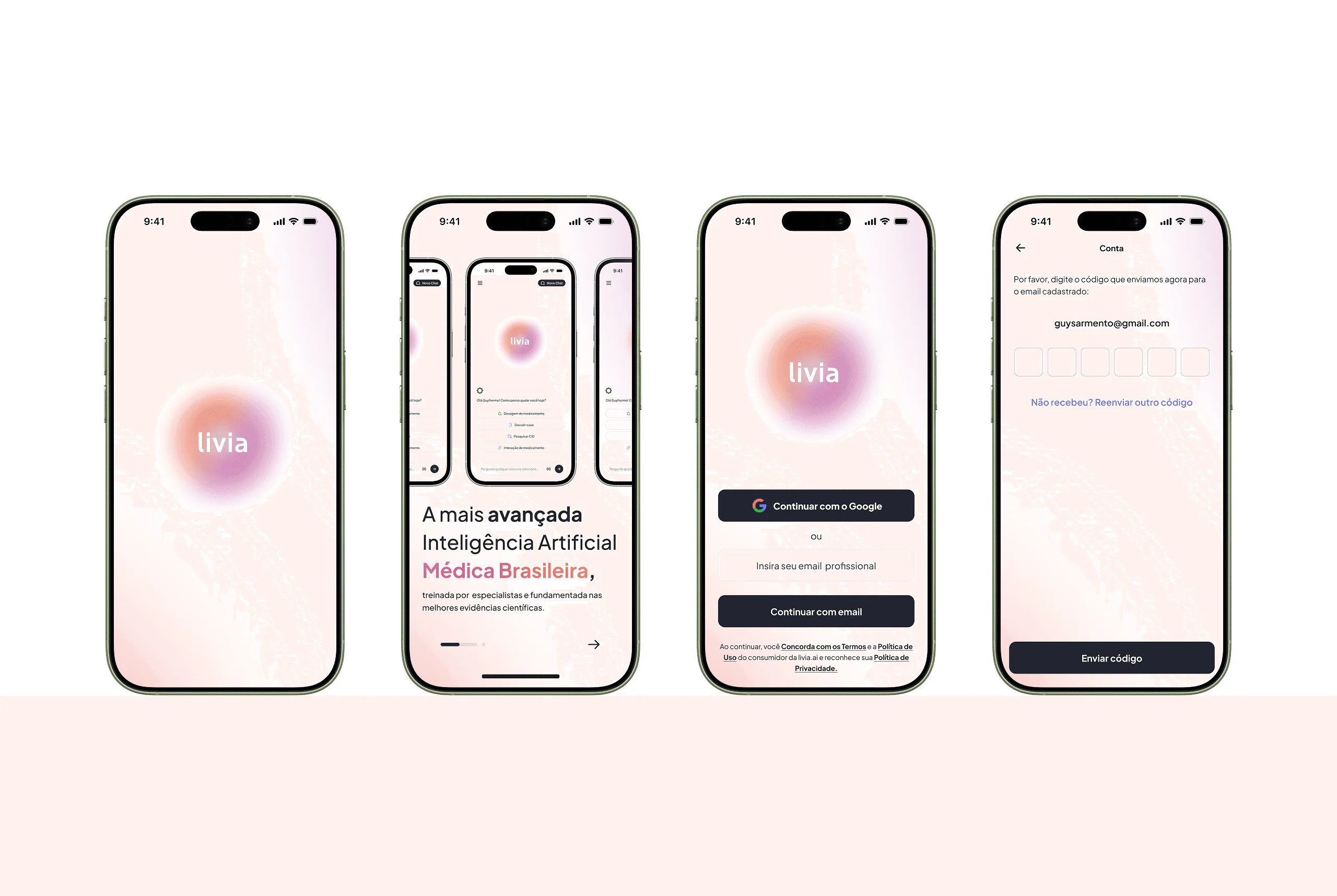
livia.app
A clinical AI assistant that helps doctors analyze cases with the best available evidence, designed to strengthen judgment instead of replacing it.
- role
- Product designer
- year
- 2025
- timeframe
- 5 months
- tools
- Figma · ChatGPT · Gemini · Lovable
- category
- Product design · brand
- design
- Sam Marxz
overview
livia Med supports each clinical decision with guidelines, systematic reviews, meta analyses and randomized trials. The product vision is simple to say and hard to design: give doctors a second brain for case analysis without ever taking the decision out of their hands.
problem
A doctor's day is a stream of information. Patient history, symptoms, exams and a body of literature that never stops growing. In fast appointments or complex cases, consolidating all of it takes time the doctor does not have, and the sources live scattered across different systems.
The risk hiding in that routine is concrete: decisions made on incomplete information, and hours lost stitching context together instead of caring for people.
immersion
Designing for this meant learning how clinical reasoning actually works. The project demanded a deep dive into medical routine, from how hypotheses form to how doctors move between symptoms, conditions and references.
The challenge was translating that investigation into interactions that feel simple, fast and reliable, without softening the precision the context demands.
solution
livia organizes the patient's information, suggests diagnostic hypotheses and connects symptoms to possible conditions, always anchored in medical references. A conversational interface handles exploration, while structured flows keep critical tasks predictable.
The experience follows the doctor across desktop and mobile, inside and outside the practice, so the assistant is present wherever the case is being thought through.
key decisions
Three principles kept the interface accountable to its clinical context.
Critical information always comes first, so the screen answers before it explains.
Cognitive load is treated as a budget, and every element has to pay for its place.
Navigation between hypotheses, symptoms and references stays fluid, because clinical reasoning is not linear.
outcome
Cases became easier to organize, hypotheses faster to reach, and the bridge between clinical data and literature much shorter. For the product, the experience now sustains a positioning built on trust.
learnings
High stakes products teach a specific kind of discipline. When UX decisions influence the quality of care, clarity stops being a style preference and becomes responsibility.